
Home / Articles / Paper-based management is still expensive: how visual communication companies are getting organized with technology
Paper-based management is still expensive: how visual communication companies are getting organized with technology
The visual communication sector does it all: storefronts, banners, stickers, signs, lettering, vehicle wraps and point-of-sale materials. A business like this depends on many details. Each order has its own measurements, material, finishing, deadline and installation. Even so, many companies in the industry still manage everything in notebooks, loose spreadsheets and conversations scattered across WhatsApp. While demand is small, that works. When volume grows, the problems start to appear.
Updated 2026-11-13 • 7 min read
Where the money is lost
For visual communication businesses, losses rarely come from one big mistake. They come from small failures repeated every day:
- Slow or wrong quotes. Calculating square meters, material and labor by hand takes time and leaves room for error. If the price is too low, the margin disappears. If it's too high, the customer goes to a competitor.
- Orders lost in production. Without a clear work order, the team prints the wrong artwork, uses another material or forgets a finishing step. The result is rework and waste.
- Missed deadlines. When nobody knows exactly which stage each job is in, the delay is only discovered on delivery day.
- Disorganized finances. Deposits received, pending balances and bills to pay are scattered in different places, and the owner doesn't know for sure how much profit the company is making.
What changes with a management system
That's why more and more companies in the sector are replacing manual control with management systems built for the reality of visual communication. The idea is to bring the order's entire path into one place: quote, approval, production, delivery and payment.
In practice, this brings:
- Faster, standardized quotes, with prices calculated from registered materials and services;
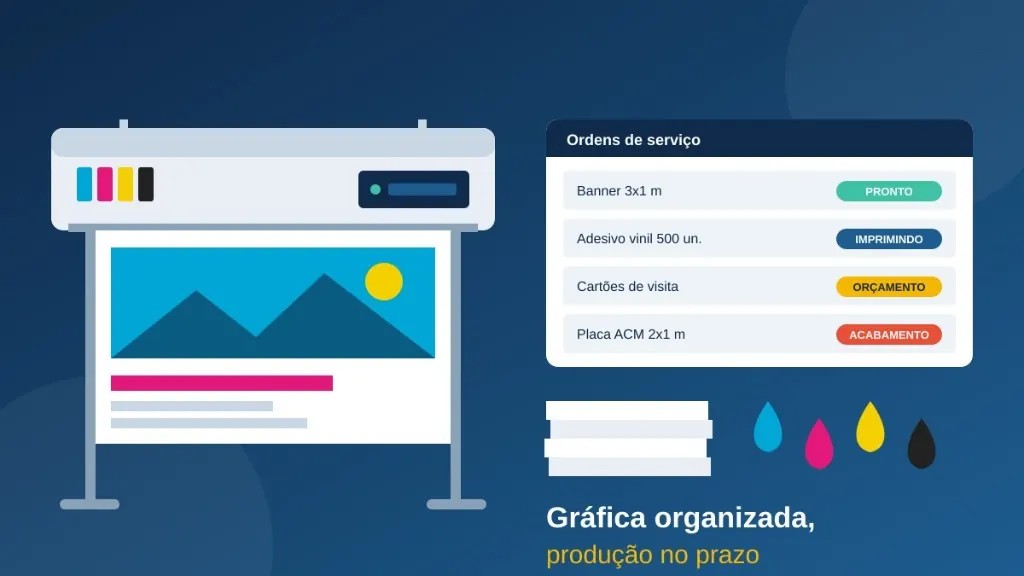
- Organized work orders that show which production stage each job is in;
- Customer records and order history, making it easier to repeat jobs and serve existing customers;
- A clear financial view of what came in, what is still to be received and how much each job earned.
One example is Elo Visual, a system developed specifically for visual communication companies and print shops. The platform brings together quotes, production and financial management in one place, and the manager follows the operation from a computer or phone.
Organization is a competitive advantage
In a market where many companies offer similar services, the ones that stand out are those that respond faster, meet deadlines and earn customer trust. And that depends much more on organization than on machines.
For the business owner, the main change is one of mindset: they stop putting out fires every day and start making decisions based on information. Digitizing management is no longer a luxury for large companies. Today it's a matter of survival for small and mid-sized businesses in the sector.
Frequently asked questions
Why is paper-based management expensive in visual communication?
Because losses come from small, repeated failures: wrong quotes, orders lost in production, missed deadlines and scattered finances. With higher volume, these errors add up and eat into margin.
What does a management system solve in practice?
It centralizes quote, approval, production, delivery and payment. The team works with clear work orders, status by stage and a financial view of what came in and what is still to be received.
Is a management system only for large visual communication companies?
No. For small and mid-sized businesses, digitizing management is no longer a luxury but a matter of survival: less rework, more deadlines met and decisions based on information.
Related modules
Work Orders for print shops with full production control
Register, track and deliver each order with better organization and less rework.
Real-time cash flow for confident decisions
Know exactly what comes in, what goes out and your operating balance.
Complete management system for quick-print shops
From sale to delivery, from cash to reports: everything in one platform.
Related reading
Why have a print shop management system?
If your operation still depends on spreadsheets and scattered notes, this guide shows the practical gains of centralizing everything in one system.
How to manage print shop finances without spreadsheets
Isolated spreadsheets make cash forecasting hard. Learn how to centralize your print shop finances with reliable data.
The best way to manage a print shop: from first contact to delivery
Managing a print shop isn't just logging orders. It's connecting areas with a single flow and simple indicators.